Experiments
Lighting in the club Code: Lighting
Intention – The production I am completing is very reliant on good lighting, and achieving that neo-noir look many films have. This experiment is therefore testing different lighting techniques and blocking that I may be able to use in my final production. The club I am filming in is very dark, and has a red undertone, therefore I need to find a way to set up lighting without ruining the vibe of the club. I am going to try this experiment through different methods of lighting (such as the 2 light setup) and practical lighting. This experiment will make the club scenes much more realistic, and therefore more engaging.

I am trying to achieve a shot that shadows the left half of the subject’s face, this is a sort of symbolic code I am trying to convey through the film; the fact that the protagonist has a good and bad side. Essentially, this is relating to the idea of having a devil and an angel on each shoulder, the protagonists’ friends act as such, and their influence on him has a huge impact on how the film plays out.
Equipment – DSLR Camera, Tripod, Led studio light, Redhead light, Small LED light (with orange gel).
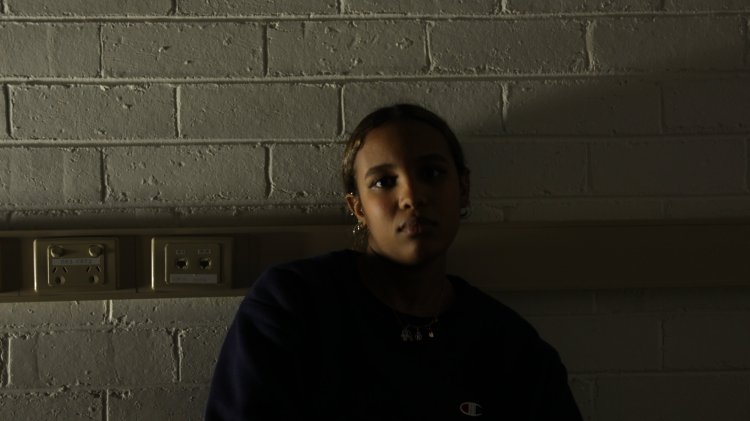
Process – While conducting this experiment, I decided to use 2 different key lights (at different times) to light the model. Firstly, I used a normal LED studio light to light up the left side of the frame. I wanted to highlight this point on the subject to symbolise a shadow and a physical note on ones own good and bad morals.
The use of the LED light was great, but I felt that the frame lacked depth, so I added a small LED light with an orange gel as a backlight to the right of the subject. The backlight created a more even image, and even worked with the idea that it was supposably shot in a nightclub. The orange gel made the image appear quite warm, but in contrast with the studio light it created the perfect image. Through adding a second back light, there was a definition between the subject and the wall, and the final image is more engaging and realistic.

I also experimented with the redhead light, but I found it too strong for the ominous tone I was going for. The redhead lit up the room a lot more, and casted a warmer tone onto the subjects face, which was not the style I was trying to achieve.
During the process of this experiment, I used verbal commands such as ‘spark’ when I turned the lights on. This was used as a safety precaution to assure that everyone knew when the lights were going on and who was in charge of them.
Evaluation – The experiment was difficult to create, as I have very little prior knowledge of lights. I had to do some research into the 2 point lighting system, and how to create depth in a photograph. Overall, I was able to meet the expectations I had for my experiment. I was able to create the neo-noir style, while also making a realistic shadow fall onto the subjects face. I wasn’t able to take these shots in the actual location, but the lighting room I used had a brick wall and through using the small LED light, I was able to recreate what the room will look like when I am actually shooting. Specific audiences will be engaged in this product through the use of shadows and the colourful (orange) lighting used to create the club vibe. This style is hinting from the neo-noir genre, therefore it will engage audiences who like the genre, and critiques. The use of the shadows to symbolise the good and the bad in a person is also engaging to an audience, as it is hinting at future events and therefore asking the audience to continue watching this character’s journey.
I also plan on having the lights primarily blue and red, this is significant as it is a continuous motif through my film symbolising crime. The shadows will be red and blue, which is another play on ones good and bad side, again engaging an audience as it is a form of character development, and gives more depth to the story.
In this experiment, I learnt how to properly set up a 2 point lighting sequence, and therefore how to differentiate the subject from the background, giving more depth to an image. I wanted to achieve an ominous style, and was able to do such thing with the use of one main light and a smaller light at the back. This has helped me understand how I will set up the bar scenes, and how I will use lighting to develop my characters.
Camera SpinCode: Camera
Intention – A very simple experiment, this will involve me learning how to use camera angles to portray drunkenness and unease. I am hoping to learn how to spin the camera around a subject with ease, from a lower angle to express their psychological status. This is important for my narrative, as this camera technique will be used when the protagonist is standing alone in the club, it is ultimately a visual clue of how he is feeling. This spin could also be used to change perspective, and therefore I am hoping to just get a clear spin around the subject from point A to B. This spin is seen in various films such as Train-spotting and Skins to pinpoint what the protagonist is looking at/for. This technique will engage an audience, as it is an unusual camera movement that brings the audience in to a personal level of the subject. I plan on conducting this experiment by using a camera arm and walking around my subject, I prefer this over the dolly as it will give me more freedom to move around.
Equipment- DSLR Camera, Camera arm, Image stabiliser (Final Cut Pro X).
Process- This experiment was relatively easy to conduct, as it involved me simply learning how to spin around a subject while keeping focus. I tried a few times to get a good angle and pace, and evidently the final product was a little out of focus, which I believe added to my desired effect. I used certain key phrases such as ‘Camera Rolling’ and ‘Cut’ when I was filming to make sure the crew (my friends) were certain what they were doing and where we were at in the experiment.
I ended up using an image stabiliser in Final Cut Pro X with this final video to give it a calmer flow, therefore giving the audience an easy way into the person’s head.
Evaluation – After conducting this experiment, I was able to understand how to properly create a camera spin. I didn’t end up filming from a lower angle, but in the end I don’t think that altered the aesthetic I was trying to achieve. I think that it was best to use a camera arm rather than a dolly as it gave me more freedom of movement, but this also meant that it was a struggle to maintain a good focus on the subject during filming. This particular camera movement will hopefully be stylistically pleasing and draw in an audience, but without hindering the real message of my film. I plan on using this type of spin in my final filming, either as a transition or a way to make the audience see through the protagonists’ eyes.
Dolly Zoom Code: Camera
Intention – The dolly zoom is a significant point in any film that uses it. It often comes with a realisation, dramatic change or uneasiness. This experiment will involve me learning how to properly complete a dolly zoom for my final SAT. The protagonist of my film comes to a realisation near the end of the film once he realises what he has done, and this realisation will be shown through a slow dolly zoom. Essentially, he will have fallen over, and upon seeing writing on the wall he will have a pivotal point of realisation. This camera movement will be difficult to achieve, due to the technical aspects involved such as keeping focus while getting the right movement. After completing this experiment, I will have learnt how to create the dolly zoom to how I like it. It is important that I pinpoint how to do this correctly, due to the fact that the major peak of the film is at that moment.
Equipment- Dolly, Tripod, DSLR Camera
Evaluation- After many attempts at the zoom, I managed to get it how I wanted. It was difficult due to the need to keep focus while moving the camera and zoom, but after completing it I was very happy with the results. I think I could work more with the camera movement by getting some more help, but overall it was quite easy to re-create once I knew the tricks. Audiences would be engaged with this type of camera movement, as it is a physical rush that the viewers can see and the protagonist experiences. Essentially, it means that the audience will be able to understand the psychological impact that this point of the story has on the protagonist. This hasn’t necessarily changed the direction of my film, but it has given me the chance to explore different camera movements and techniques that will engage my audience and leave them not passive.
Over the shoulder trackingCode: Camera
Intention – Although I have tested many different camera movements, I think that the over shoulder shot is a vital aspect that I will be using continuously throughout my film. Therefore, this experiment is testing the different ways to shoot over the shoulder, and the different scenarios of such. I am hoping to master this type of shot after completing this experiment, and through such I will be honing down on a vast number of shots in my film. These shots generally engage audiences, as it is an almost personal shot, it is what the protagonist is seeing, but also a reminder that the audience is watching them and that they aren’t the actual character.
Equipment- Camera arm, DSLR camera
Process- I used a camera arm first, but it was very shaky and didn’t let me smoothly shoot my subject. Even after experimenting with the stabiliser in Final Cut Pro X, the images weren’t as good as they were once I tried tracking with a dolly (see over the shoulder 3).
Evaluation – I eventually met the outlines in my intention after several experiments with different equipment. Initially, I tried filming with a camera arm, but this proved difficult due to the shakiness of the final footage. I think this kind og shot will be useful in some of my experiment (where I am shooting the subjects walking while they are intoxicated), but in the majority of parts I want a clean shot. I re-did the experiment therefore with a dolly, and the footage was a lot cleaner and nicer. Audiences would be engaged in this style of filming, as it makes them feel like they are following the person’s story, and not like they are just passive viewers. I have now learnt how to successfully create a clean over the shoulder tracking shot that I will be using liberally in my final SAT.
 eddingtonpress