Genre and Style
The research that I have conducted of various media products has strongly influenced the creation of my short film. The stylistic choices have been heavily outlined in many areas of my research portfolio, and thanks to that I have commented on many products due to their use of lighting and colour. I plan on having an visually engaging film, through the use of neon lighting (e.g. red and blue – which is also a motif used through my film acting as a visual representation of crime) and a vibrant colour pallet, but also through an engaging narrative with story a 3-act story structure and a moral character arc.
My media product has one main message that I want to convey, that is that actions always have consequences. Although the style I am interested in is quite popular, I will be rendering it unique with the use of mise en scène graffiti to push the narrative along. The confronting words on the walls such as ‘don’t be a pussy’ are not often seen in neo-noir drama style films, and often films look over the impact their actions could have on women. I have therefore used a type of lamp-shading in my product (a technique of making something super obvious to the viewers) to call out the actions of the protagonist, and everyone in real life who carry themselves around like he does.
Much of my research looks more into the visual aspects of my film rather than the actual story, but even these specific codes and conventions in products that I have researched prove a great starting point to create my own product. I have commented on the use of lighting at night, and colours to express emotions. I will channel these aesthetics into the production of my film, and the characters in many of the music videos i cited in my research have inspired the characters in my film.
I have planned my experiments to my script, focusing on the cinematic codes CAMEL and sequence of events. Many of the experiments involve the use of lighting and camera movement, and I want to learn how to create these effects before shooting the real product. I have a large number of experiments that I will complete which focus on various important aspects of my film, such as the graffiti on walls or makeup to make the protagonist look pale and defeated. Through conducting these experiments I will have a perfected view of how my final product will turn out, and therefore it will be easier to film as I will have already made mistakes and learnt how to fix them.
The style of my final narrative is focused of aspects such as sound, lighting and acting. The lighting will be dark, ominous and moody (e.g. nightclub scenes, Irréversible), with colours of red and blue to work as a continuous motif of crime and wrong doing. The sound is also a significantly important aspect of my film; the first few scenes are set in a club which means getting the sound of a conversation over the surrounding sounds (music and conversation). The acting is the last major point of my film, as I am reliant on the actor’s ability to portray believable emotion on their face.
The Anti-Hero and Femme Fatale
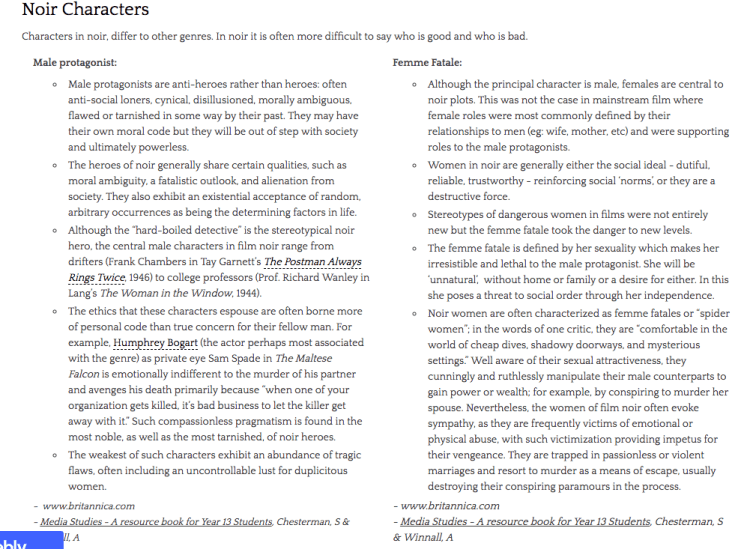
The anti-hero in film refers to a central character in a story, film, or drama who lacks conventional heroic attributes. Often this character is conventionally evil, but is needed in order for the narrative to move forward. Male protagonists in noir films are often seen as anti-heroes (see reference) and they are usually outcasts of society. Although the main protagonist in my film is not an outcast to society, his actions are often condoned and although he is the main lead, he is the anti-hero of the story. Costa has a moral ambiguity, a trait often seen in anti-heroes, and his ethics are more concerned around his own self achievement than others. There are many famous anti-heroes in film, but a note-able is the old film star; Humphrey Bogart. His characters are often self-centred, privileged and indifferent to others opinions. Costa’s personality is similar in this way, although unlike most Bogart films, Costa comes to realise the affects of his actions and becomes the hero of the story.
The femme fatale is the seductress, and the manipulater in many films. She uses her looks to make men do what she wants them to do, and through this she controls her independence. Although my film doesn’t have a conventional ‘Femme Fatale’ Essie acts in place, and through Costa’s eyes she is this type of woman. She is the mouse he is hunting, yet she ends up taking control of the situation and putting Costa in his place, like many ‘femme fatale’.
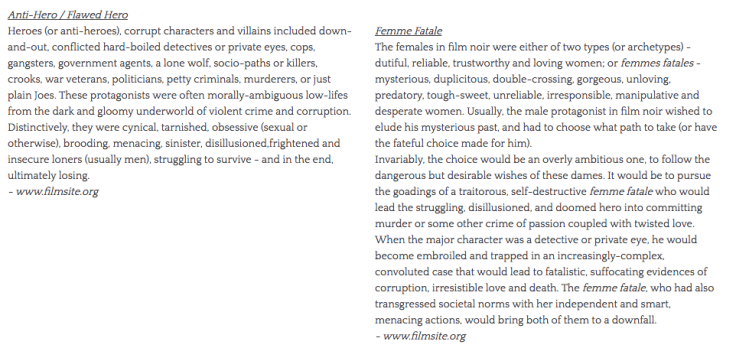
These screenshots outline the general conventions that are associated with these typical ‘noir’ characters, and reveals the importance of such characters in film.
Auteurs and References
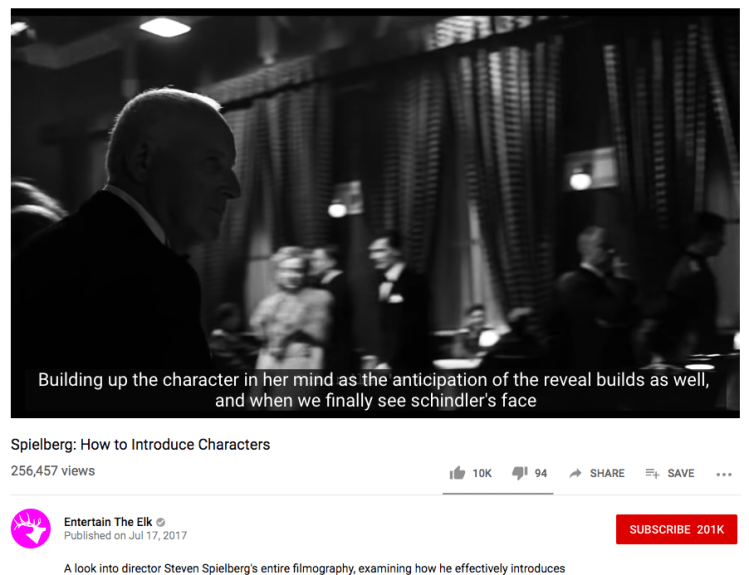
Steven Spielberg
Steven Spielberg’s films always go by the idea that first impressions are always vital. He introduces characters through visual and sound cues in order to engage the audience and create an anticipatory essence to each character. It is known that actions speak louder than words, and through introducing characters through such means, the audience can always interpret who is who and what their means are in the narrative.
A great opening to a ‘bad’ character in a film is experienced through the ominous teasing of on screen reactions and cinematic notes. We can tell that this person or thing is important/villainous/ noteworthy due to the introduction to them and how others react. We don’t need to physically experience them on screen to know who they are. Spielberg uses this in order to create mystery, though showing only what the audience needs to see, may that be something in the character’s hands, a broken leg or a specific object. This makes the audience active participants and draws in more engagement and therefore more character development.
An example of using visual cues to introduce a character is in one of Spielberg’s famous films; E.T. The antagonist doesn’t show his face for the first 2 acts of the film, and the audience only knows who he is by the jingle of his keys. Through only seeing this character through following his keys, the audience experiences a build up of suspense, and the reveal is therefore much more intense.
This use of character introduction will be incredibly helpful in my film, as it will help form Costa’s character before he is even portrayed on screen. Through close ups of his unlit cigarette, the people around him and the atmosphere, the audience will better understand him as a character one his face is shown.
Character Style
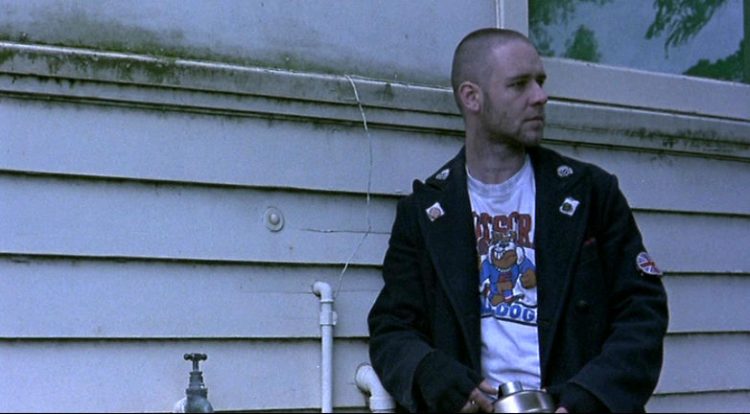
Hando – Romper Stomper
Romper Stomper is a ominous film that focuses on fascist ideologies and violent acts. This is not the reason why i’m using this film as an inspiration, rather it’s the way that the character ‘Hando’ is portrayed. He is a rough looking man, who thinks that the world revolves around him.
His personality is more extreme than what Costa is like, but his self-righteousness and over confidence is a big inspiration to the formation of Costa’s character. His look and way he carries himself is also notable, but the fascist and racist ideals he holds is not evident in my film as it is completely irrelevant to the topic.
Cook – Skins
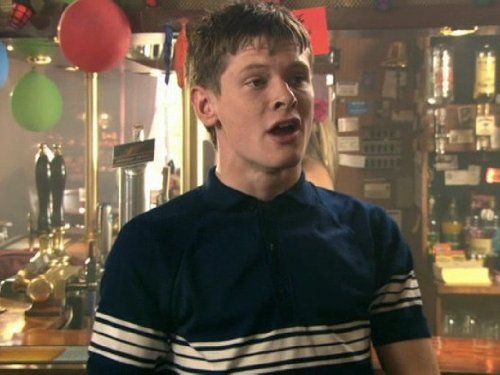
Skins has been one of the main sources of initial inspiration for my film. The dirtiness portrayed on screen of the teenager’s lives and the way their personalities intertwine is relevant to how Costa acts and his relationship with others. Cook influenced the creation of Costa; the way he interacts with others, his morals and his view on life.
The rural look and the rough edge Cook has is what I’m trying to get across on screen, even his hidden morals are important. Cook’s character development shows him from being a careless party boy, to becoming soft, upset and experiencing all sorts of emotions that crack down the rough stereotypes he associates himself with.
 eddingtonpress