Narrative
Aristotle
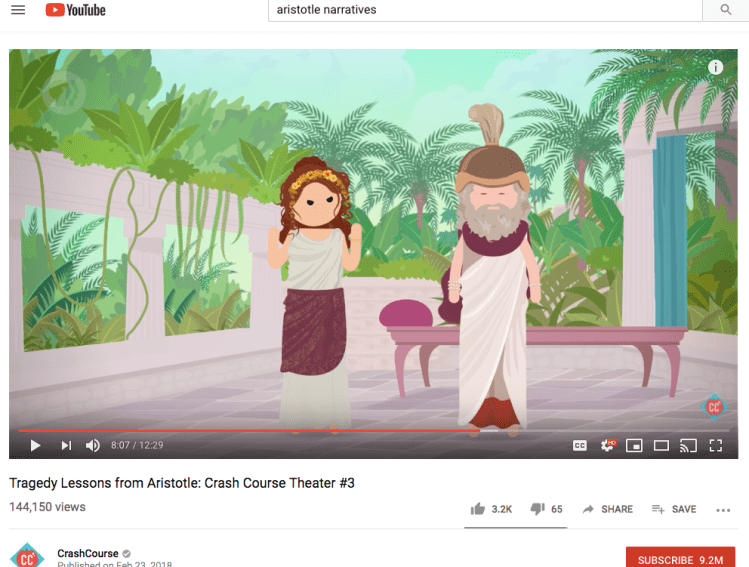
There are many artists, philosophers, musicians who follow this structure but tweak their product by manipulating style and genre. Aristotle is one of the most recognized storytellers in the world of captivating tragedies and his work is studied thoroughly by various artists who wish to tell a story. Essentially, a tragedy follows someone who wants something badly, but is having trouble getting it. To comment on this in more depth (and not in my own words) a tragedy follows a flawed protagonist who wants something badly but is having trouble getting it until they realize something about themselves, address their problem and become better humans causing the audience to experience a catharsis when the protagonist finally makes a choice that benefits the universe rather than themselves while maintaining unity of time, place and action.
Aristotle’s work suggests that all dramatic tragedies must follow a 3-act structure with a set-up (act 1 or Thesis), a confrontation (act 2 or Anti-Thesis) a midpoint, a crisis and a resolution (act 3 or Synthesis). Through this, he also noted that dramatic narratives should include a moment of catharsis, Phobos (the anticipatory fear of something happening to the protagonists), and Eleos (empathy for the protagonist).
Action not narrative is also a strong point Aristotle often expressed. It is an extremely important factor that must be adhered to in dramatic stories. Screen stories with too much dialogue often tend to bore the audience, and nothing is left for them to figure out themselves. Actions speak louder than words, and by transporting this onto the screen, the artists would find themselves successfully creating a film with an enthusiastic audience and an engaging narrative.
Joseph Campbell/ Dan Harmon

Joseph Campbell is a well know philosopher who created the idea of the Monomyth, better known as the ‘Heroes journey’. Essentially this outlines all stories ever created, it comments on the idea that every story has a rhythm and a balance. A famous creator, Dan Harmon, created the ‘story circle’ a distillation of the Monomyth in 8 steps. This ‘circle’ examines stories as being continuous, and that everything will come back to the beginning, but somehow changed. Therefore, in the 8 steps, a protagonist of a narrative will be met with 2 struggles; internal and external. To successfully overcome their external problems, they must first address their internal (mental) struggle. The structure contends that in every story there is a line between order and chaos, stasis and change. Dan Harmon uses this structure to create interesting narratives, that capture an audience’s attention.


Pulp Fiction
Structure of time
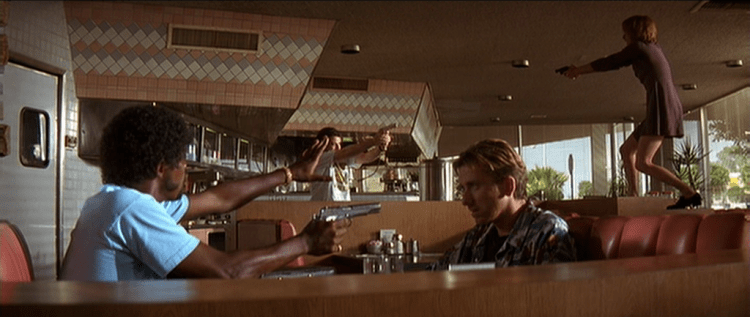
One of Pulp Fiction’s most attributable aspects is the non-linear timeline that tells the stories of 3 different protagonists. There is Vincent, Jules and Butch. The film encompasses the idea of redemption, and adheres to themes of divine intervention through bible passages and a heavily symbolic showdown in a diner. Although the narrative structure has many ambiguous meanings, I have interpreted the film in a certain way. Although the film is non-linear, it still holds the basic attributes to the 3 act structure; setup, confrontation, midpoint, crisis, climax, resolution and catharsis. The way the narrative is structured forces the audience to pay close attention due to the important elements in each time period. One of the most notable things of Pulp Fiction is the full circle ending. The film opens up in a diner, and ends in the same diner, yet the information and backstory the audience has received makes the audience regard the scenario in a whole new light. The motif of redemption that runs through the film is fulfilled, and therefore the audience finishes the film feeling satisfied and understood.
Moral Character Arc
Although there are various character arcs and development in Pulp Fiction, I have focused this study on Jules. He is the character who develops the most over the course of the film, and his motives are clear and understandable. After experiencing a near death experience, Jules relises that he isn’t satisfied with his crime-rigged life, and that even though he is incredibly successful at what he does, he is being told from god that he must change. Jules goes by the idea that he must redeem his mistakes, he was someone who had done bad things, but he has decided to throw that life away. This development is relevant in the final diner scene, as the audience see’s Jules, a one violent killer, teach another a lesson he has learnt, and still let that person walk free (with a wad of cash). He is a twisted form of ‘good samaritan’ and he acknowledges the things he must do on the way to redemption.
500 Days of Summer
Moral Awakening
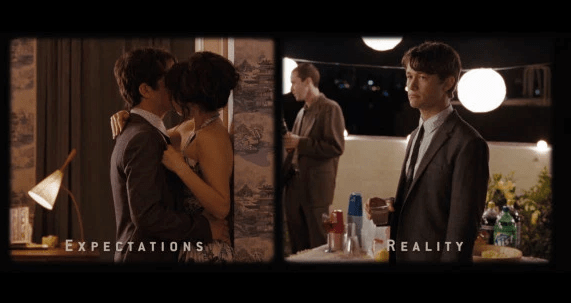
500 Days of Summer is the story of a young man ‘Tom’ as he connects with this ‘special’ girl ‘Summer’. Throughout the narrative, Tom expresses his belief in true love, and as his relationship with Summer grows closer he believes he has found it. Regardless of Summer’s constant reminders that she isn’t looking for anything serious, and that Tom isn’t ‘the one’ for her, he ignores this and falls deeply in love with her. Tom’s obsession with this girl leads him to a terrible break up, where he experiences a deep depression and heartbreak. His philosophy about finding the perfect person is almost broken, and after a lasting conversation with married Summer, he realises that she will never feel the same way. This realisation, or this ‘moral awakening’ is vital to the film, as it portrays a psychological change in mind and behaviour of a protagonist. Although even in the end of this film, Tom finds what seems to be the one by moving on from summer… even though her name is ‘Autumn’.
Conventions for my SAT
The two main things I got out of studying the film Pulp Fiction is the circular narrative, and the moral arc. My film is very similar to this story structure, as the story opens up in a bar with the protagonist acting out and celebrating his birthday, and it circles around when a cop at the end tells him ‘happy birthday’. The irony behind the statement is due to the context of what the audience has just viewed. Costa (the protagonist in my film) also experiences the ‘moral character arc’ as he begins as an arrogant asshole, but soon comes to realise the affects of his actions on others. He teaches himself a lesson, and in doing so he becomes a better person, just like Jules.
The moral awakening portrayed in 500 Days of Summer is also a play of the theme I am trying to portray in my film. Through the realisation that Summer isn’t his everything and that he must change his ways in order to love himself and then others, Tom goes through this moral awakening. Costa (the protagonist) undergoes this same thing, although on a much darker level; realising he doesn’t need to act like he does to be who he wants to be. He learns that his negative actions amount to nothing, and this is portrayed through backlash of his comments, and the relationship between him and his sister.
 eddingtonpress